
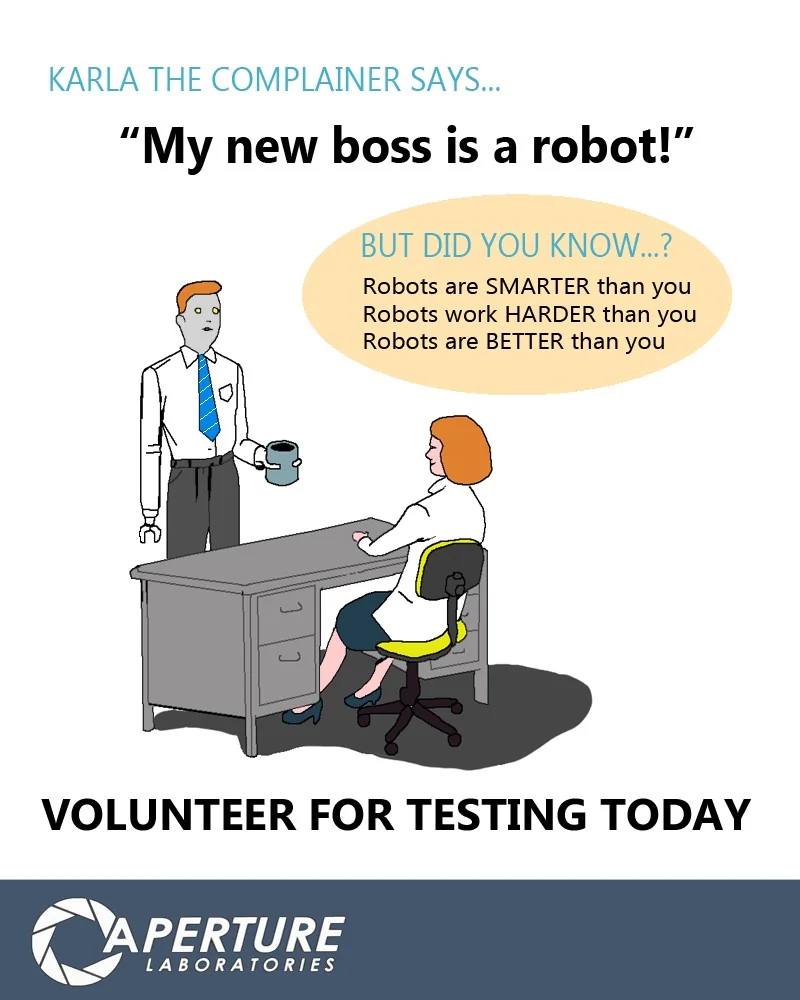
«My New Boss is a Robot!»
This intriguing statement was overheard shortly after a «Seminar on AI Integration,» where a curious individual noticed a rather thought-provoking poster displayed in their office. The poster, emblazoned with the bold declaration, immediately sparked a question in the minds of many: is this a literal statement, a metaphorical representation of the changing workplace, or perhaps a humorous commentary on the increasing role of artificial intelligence in management? The individual in question, clearly intrigued and perhaps a little apprehensive, followed up with a direct inquiry: «Should I be worried?» This sentiment echoes a growing concern among professionals across various industries as AI technologies become more sophisticated and are increasingly deployed in roles that were once exclusively human domains. From automated customer service bots to AI-powered project management tools, the lines between human and machine are blurring. The question isn’t just about job displacement, but also about the nature of leadership, decision-making, and the human element in the workplace.
Navigating the AI-Powered Workplace
The integration of AI into our professional lives is no longer a futuristic concept; it’s a present reality. Seminars like the one mentioned are becoming commonplace, aiming to equip employees and leaders with the knowledge and skills to adapt to these transformative changes. While the poster might be a playful exaggeration, it highlights a genuine shift. AI can indeed take on tasks traditionally performed by managers, such as scheduling, data analysis, performance tracking, and even initial candidate screening. This can lead to increased efficiency, reduced bias in certain decision-making processes, and the freeing up of human managers to focus on more strategic and empathetic aspects of leadership.
Understanding the Potential Benefits and Concerns
- Efficiency Boost: AI can automate repetitive tasks, allowing human employees to concentrate on more creative and problem-solving activities.
- Data-Driven Decisions: AI can process vast amounts of data to provide insights that might be missed by humans, leading to more informed strategies.
- Objectivity: Well-programmed AI can reduce human bias in areas like hiring and performance reviews.
However, the «robot boss» scenario also brings valid concerns to the forefront. The nuances of human interaction, emotional intelligence, motivational leadership, and ethical considerations are areas where current AI still lags significantly behind human capabilities. The fear of job displacement is also a significant factor, alongside anxieties about a loss of personal connection and the potential for overly rigid, data-dictated management styles.
The individual’s question, «Should I be worried?» is understandable. The answer, however, is not a simple yes or no. It’s more about adaptation and collaboration. Instead of viewing AI as a replacement, it’s more productive to see it as a powerful tool that can augment human capabilities. The key lies in understanding how to effectively work alongside AI, leveraging its strengths while ensuring that human oversight and judgment remain paramount, especially in areas requiring empathy, creativity, and complex ethical reasoning. The future of work likely involves a synergy between human intelligence and artificial intelligence, creating a more dynamic and efficient, yet still fundamentally human-centered, professional environment.
Discover how to thrive in the evolving workplace. Learn More About AI Integration
Contacts: https://t.me/MLM808