
GPT-4 🆚 GPT-3.5: A Detailed Performance Comparison
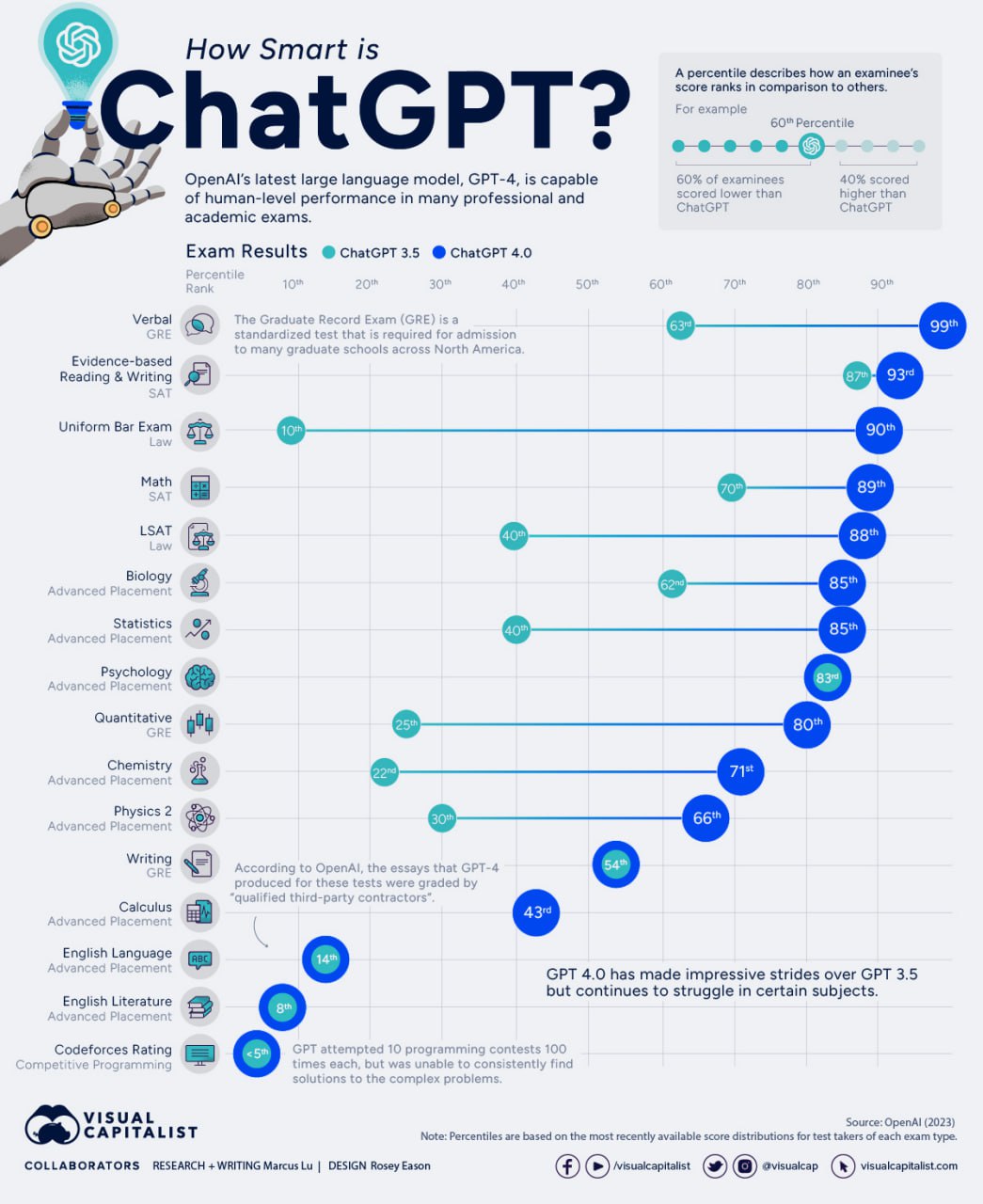
The latest advancements in AI language models are truly remarkable, and a recent visual comparison between GPT-4 and its predecessor, GPT-3.5, highlights significant leaps in certain domains. This analysis, meticulously conducted by Visual Capitalist, uses clear graphical representations where a position further to the right indicates superior performance. The findings reveal that ChatGPT-4 has made substantial gains in specialized fields such as law, chemistry, and physics. Conversely, its progress in areas like programming, the English language, and literature appears to have plateaued, showing no notable improvement over GPT-3.5.
Understanding the Performance Metrics
The Visual Capitalist study provides an in-depth breakdown of each evaluated category. The charts clearly illustrate where GPT-4 excels and where it maintains parity with GPT-3.5. This nuanced understanding is crucial for developers and researchers seeking to leverage these powerful AI tools.
Key Areas of Improvement for GPT-4:
- Jurisprudence: GPT-4 demonstrates a markedly enhanced ability to comprehend and process complex legal texts, likely due to improved reasoning and contextual understanding. This makes it a more capable assistant for legal research and document analysis.
- Chemistry: The model shows significant progress in handling chemical concepts, equations, and data, suggesting a deeper grasp of scientific principles and terminology.
- Physics: Similarly, GPT-4 exhibits superior performance in physics-related queries, indicating enhanced capabilities in understanding theoretical concepts and problem-solving.
Areas with No Significant Advancement:
- Programming: While GPT-3.5 was already proficient in coding-related tasks, GPT-4 has not shown a quantifiable improvement in this area. This suggests that the existing architecture might already be near optimal for many programming applications.
- English Language: Despite the general advancements, GPT-4’s performance in core English language tasks, such as grammar, comprehension, and nuanced expression, appears to be on par with GPT-3.5.
- Literature: The model’s ability to analyze, generate, or interpret literary works has not seen a significant boost, indicating that its creative or analytical literary capabilities are similar to its predecessor.
Implications for AI Development and Application
This comparative analysis offers valuable insights for the future direction of AI language model development. Focusing resources on areas where GPT-4 shows improvement, such as scientific and legal domains, could lead to even more specialized and powerful AI applications. For users, understanding these differences allows for more informed choices about which model best suits their specific needs. Whether you’re a legal professional seeking enhanced research capabilities or a student grappling with complex scientific theories, the advancements in GPT-4 are worth exploring.
For a deeper dive into the methodology and a full overview of the results, please refer to the [original Visual Capitalist report](/visual-capitalist-report). Exploring the nuances of these AI models can unlock new possibilities in various fields, from academic research to professional services.
Ready to explore the cutting edge of AI? Discover how these advanced language models can transform your workflow.
Contacts: https://t.me/MLM808